Your Guide to VA Home Loan Benefits
Whether you’re a veteran, active-duty service member, or military family, get expert guidance from eligibility to closing and make the most of your VA benefits.
Meet The VA Loan Boss
Mark Clark is a civilian benefit and certified VA loan specialist . VA loans are incredibly powerful but also widely misunderstood. His job is to cut through bad advice, explain the rules clearly, and make sure veterans and active-duty service members actually receive the full benefit they’ve earned.Mark is known as the Veteran Mortgage Wingman here to serve, advocate, and help VA buyers avoid costly mistakes from contract to closing and beyond.
Whether you're a veteran purchasing your 3rd home on your VA benefit or PCSing and a first-time homebuyer, our team has you covered.
Education is central to how Mark does that, including teaching VA-focused classes for real estate professionals so VA buyers are better represented throughout the transaction.Outside of work, Mark is married, a proud father of six, and loves to play racquetball and pickleball.
Mark also serves as the the Board Chair for Genesis Joy House, Georgia’s only all-women Veteran homeless shelter because serving those who served doesn’t stop at the closing table.
The Home Loan Process
Mortgage Pre-Approval
Get pre-approved from one of our Loan Officers to see how much you can afford.
House Shopping
Work with a trusted Real Estate Agent to find a home you would like to move into.
Loan Application
Complete your home loan application to get the lending process started.
Don't take my word for it
Mortgage Programs
Experience the best mortgage experience located in Braselton, Georgia.
Home Loan Options
Our experienced mortgage advisors will walk you through the best mortgage loan program that will fit your specific scenario.
Conventional Home Loans.
FHA Home Loans.
USDA Home Loans.
VA Home Loans.
Frequently Asked Questions
How often can I refinance my mortgage?
There is no limit to the number of times you can refinance. However, you must qualify every time you apply and there will be costs associated with closing the loan each time.
Can I buy a home if I do not have money for a down payment?
Yes! There are a number of bond programs that offer low or no down payment financing options.
How do I know which mortgage is right for me?
The key to choosing the right mortgage is to understand the range of options and features available to you, as well as your budget, circumstances, and goals. Our licensed mortgage professionals are here to help you navigate that process. The more you know, the more comfortable and confident you will be choosing the best option for you and your family.
How long will the loan process take?
The Truth in Lending Act (TILA) does not permit a lender to close a loan until at least seven (7) business days have passed from the date your application was received. A typical home loan takes 30 days, as a number of third-party services such as appraisals, title work, and credit are required in conjunction with the mortgage process. Once you familiarize your Loan Officer with the details of your specific loan scenario, they will be able to provide you with a more specific timeline.
Will I qualify for a home loan?
The only way to find out is to speak with a qualified mortgage professional. Our Loan Officers have helped numerous clients who didn’t know if they could qualify to become home owners. We take the time to understand your financial situation and long-term financial goals, and then match you with the loan program that best fits your needs. Your approval for a loan may also largely depend on the price of the home you are financing. Getting pre-qualified prior to beginning your home search can give you an idea of what you may be able to afford.
Why do people refinance their mortgages?
Homeowners typically refinance to save money, either by obtaining a lower interest rate or by reducing the term of their loan. Refinancing is also a way to convert an adjustable loan to a fixed loan or to consolidate debts.
How much money will I have to pay upfront to buy a home?
This question does not have a simple, one-size-fits-all answer. The exact amount will depend on the price of the home you buy as well the type of mortgage financing you choose. Depending on your loan program, your down payment could be as much as 20% of the home’s price or as little as 3%, while some loans require no down payment at all.
Can I get a mortgage after bankruptcy?
You may still qualify for a home loan even if you have experienced a bankruptcy. The best way to find out if you qualify is to talk with a Loan Officer to discuss your options. Be sure to bring all paperwork regarding your bankruptcy so your Loan Officer can find the program that best fits your situation.
Should I lock my interest rate now, or wait until we are closer to our closing?
Interest rates fluctuate all day, every day. If an interest rate is good, it may be in your best interest to lock now. If you wait, you run the risk of an increase in rates later. If you are concerned that rates may go down after you lock, contact your Loan Officer to discuss your options. Some programs allow you to lock for an extended period and choose to lower your rate should a better one become available.
Most Recent Blog Updates
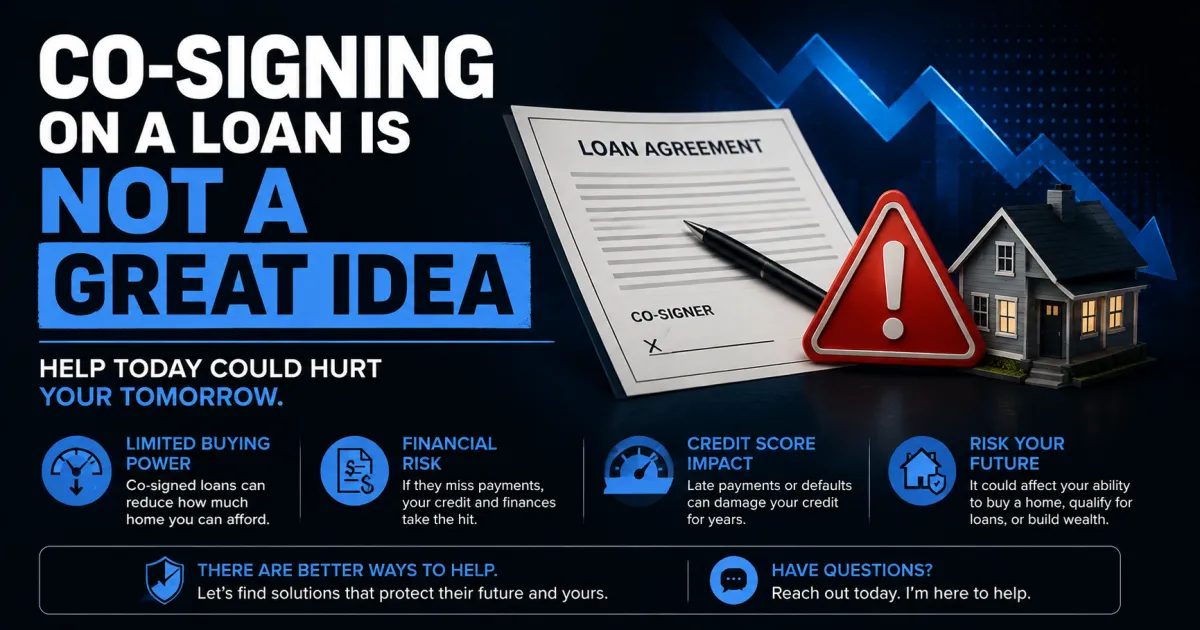
Co-Signing a Loan Can Destroy Your Financial Future and Here Is What to Know Before You Say Yes
The Generous Decision That Can Cost You For Years
Wanting to help a friend or family member is noble. Co-signing a loan to make that help happen feels like a natural extension of that generosity. It is also one of the most financially consequential decisions a person can make without fully understanding what they are agreeing to and Mark Clark has seen it derail homeownership dreams more times than he can count.
What Co-Signing Actually Does to Your Financial Picture
When you co-sign on someone else's loan that debt appears on your credit report as your obligation. Not theirs. Yours. The lender considers the full payment when evaluating your debt-to-income ratio regardless of whether you are the one making the payments every month.
That means if you have co-signed on a car loan, a personal loan, a student loan, or a mortgage for someone else every dollar of that payment is working against your ability to qualify for your own home when the time comes. You may not be able to buy at all. Or you may qualify for significantly less than you otherwise would because of an obligation that was never intended to be yours long-term.
Mark Clark has worked with many clients who came to him ready to purchase a home only to discover that a co-signing decision made years earlier to help someone they cared about was now limiting what they could do for themselves.
The National Guard Member Who Almost Made a Costly Mistake
A National Guard member recently reached out to Mark wanting to help his sister get into a home. She needed the support and he wanted to provide it. The impulse was genuinely good.
The conversation that followed was the kind of frank and honest discussion that Mark believes is part of his job regardless of whether it leads to a transaction. They walked through exactly what co-signing would mean for the National Guard member's own financial future. What it would do to his debt-to-income ratio. How it could affect his ability to use his VA loan benefit when he was ready to buy his own home. What the long-term exposure looked like if his sister ever missed payments.
And then they found other ways he could help his sister that did not require putting his name on her debt. That outcome serves him and serves her far better than a co-signature would have.
Why This Conversation Matters
Mark Clark is not in the business of just processing transactions. He is in the business of helping people make decisions that serve their long-term financial wellbeing. Sometimes that means talking someone into a purchase. Sometimes it means talking someone out of a decision that feels generous in the moment but carries consequences they have not fully considered.
If you have questions about co-signing or how a past co-signing decision might be affecting your ability to buy a home reach out to Mark Clark. The conversation is free and it might change the direction of your financial future.
Sources
ConsumerFinancialProtectionBureau.gov
MyFICO.com
MortgageNewsDaily.com
Investopedia.com
FannieMae.com

Mortgage Calculator
See your total mortgage payments using the tool below.
| Year | Interest | Principal | Balance |
|---|